El tema central de este Blog es LA FILOSOFÍA DE LA CABAÑA y/o EL REGRESO A LA NATURALEZA o sobre la construcción de un "paradiso perduto" y encontrar un lugar en él. La experiencia de la quietud silenciosa en la contemplación y la conexión entre el corazón y la tierra. La cabaña como objeto y método de pensamiento. Una cabaña para aprender a vivir de nuevo, y como ejemplo de que otras maneras de vivir son posibles sobre la tierra.

miércoles, 9 de mayo de 2012

La cabaña, una experiencia radical en el cineasta coreano Kim Ki-duk


Kim-ki-duk 


Kim Ki-duk - Arirang (2011)


En mai 2011, après une "disparition" de trois ans, le célèbre réalisateur sud-coréen Kim Ki-duk revint au Festival de Cannes pour présenter son nouveau film, Arirang, dans la section "Un certain Regard". Le film n'a rien à voir avec ses précédents films, quinze tournés en treize ans, et presque tous excellents, parmi lesquels on peut citer L'Île (2000), Bad Guy (2001) et Locataires (2004). Arirang est un film expérimental tourné avec un Canon D5 Mark II, avec Kim Ki-duk pour seul acteur. Celui-ci se filme en pleine dépression alors qu'il vit depuis trois an en autarcie dans une cabane en bois. Dans ce film cathartique, on comprend très vite pourquoi Kim Ki-duk avait cessé son travail de réalisateur.

Pour lutter contre le froid, Kim-Ki-duk a installé une tente dans sa cabane.

Kim Ki-duk nous montre ses talents manuels en construisant une machine à café.

Pendant le tournage de son précédent film, Dream (2008), l'actrice principale, Lee Na-young, avait failli mourir lors d'une scène de pendaison. Plus de peur que de mal, heureusement. Très choqué par cet événement, Kim Ki-duk a commencé par remettre en question tout son travail de cinéaste. DansArirang - la chanson traditionnelle et folklorique de la musique coréenne la plus connue - Kim Ki-duk se filme lors des derniers mois de sa "retraite", au début de l'année 2011. Comme l'écrit Excessif, "ce qui est impressionnant, c'est que cette auto-psychanalyse est clairement montée comme une œuvre posthume, comme s'il avait pensé se tirer une balle dans la tête avant même de la finir". Une œuvre "différente" de cinéma-vérité qu'on aimera ou qu'on détestera en criant au nombrilisme et à l'onanisme.

Kim Ki-duk répond à son ombre.


Arirang es un documental autoreflexivo que Kim Ki-duk nos presenta de la siguiente manera:

“Arirang es una historia en la que Kim Ki-duk interpreta tres papeles. A través de Arirang, franqueo una colina de mi vida. A través de Arirang, intento comprender al ser humano, le doy las gracias a la naturaleza y acepto mi situación actual. Estamos ahora en el mundo de los hombres, donde se entremezclan los deseos, en el mundo de los fantasmas, repleto de dolor, y el mundo imaginario, donde se esconden nuestros sueños, sin principio ni final, volviéndonos locos lentamente. ¿Qué es el afecto, que anida aquí y allí en mi corazón y me pudre de esta forma? ¿Por qué se mantiene sobre mi cabeza para cuestionar mis emociones? ¿Por qué se esconde en el fondo de mi corazón para poner a prueba mi compasión? Cuando no le abro mi corazón a alguien, me convierto en una mala persona y le olvido, pero cuando le abro mi corazón, no le dejaré partir nunca, como un ser despreciable. ¡Oh, Arirang! De acuerdo. Matémonos cruelmente en nuestros corazones hasta la muerte. Incluso hoy, aún controlándome, me dejo invadir por la rabia con una sonrisa en los labios, me estremezco de celos al querer, odio al tiempo que perdono, tiemblo mientras ardo en ganas de matar. Esperad. Voy a suicidarme, yo que me acuerdo siempre de vosotros.”


Rompe años de silencio en Cannes
Kim Ki-Duk se confiesa

El surcoreano Kim Ki-Duk, uno de los cineastas más solicitados del circuito de festivalesinternacionales en la primera década de siglo, habla a corazón abierto, tras años de silencio en 'Arirang', la película que trajo a Cannes.
Desde su debut 'Crocodrile' (1996), el cineasta saltó rápidamente al estrellato con su tercera película, 'La isla', distinguida en Venecia. Tras más de una quincena de cintas y cosechar todo tipo de premios, el cineasta desapareció tras estrenar en 2008 'Bi-mong' ('Dream'). La causa fue que una de sus actrices sufrió un accidente por el que casi pierde la vida.
Las circunstancias de los hechos no llegaron a esclarecerse del todo y circularon informaciones que señalaban un intento de suicidio por parte de la actriz. El hecho es que desde que se estrenó esa cinta, Kim Ki-duk desapareció de la vida pública y se recluyó en una precaria cabaña en una zona boscosa de su Corea natal, donde vive aislado, como un ermitaño sin agua corriente y con un limitado suministro eléctrico.
Todo ello lo muestra en 'Arirang', la película que ahora presenta en la sección Un Certain Regard. Empujado por la necesidad de rodar, el autor de las aclamadas 'Hierro 3' (2004) o 'Primavera, verano, otoño, invierno... y primavera' (2003) se compra una pequeña cámara, la coloca en su cabaña delante de él a forma de espejo y comienza a hablar de todos los fantasmas que le han acompañado estos últimos años.
Kim Ki-Duk relata cómo ha vivido aislado, sin amigos y evadiéndose con la bebida. Además, cuenta la traición que sufrió por parte de algunos colaboradores, reflexiona sobre su papel como cineasta, sobre los límites de su oficio y la contradicción que suponen los premios.
La dureza y precariedad de su vida solitaria y la honestidad a la hora de exponerla difícilmente las ha mostrado antes en la gran pantalla cualquier otro director. "Muchos considerarán esta película un documental, pero para mí es un drama", afirma el realizador en el metraje.
"Hacerle justicia en una breve crítica es imposible. No sólo porque Kim proporciona una comprensión revolucionaria sobre su línea de trabajo, sino porque también aborda temas que muy a menudo son ignorados como irrelevantes o pedantes por parte de profesionales que deberían tener un conocimiento más profundo", dijo el crítico de 'Screen'.
'Arirang' es el título de una canción coreana que conmueve profundamente al director e incluso le hace llorar. También el espectador queda desarmado al ver como el cineasta abre su alma.
(Fuente: http://www.elmundo.es/elmundo/2011/05/16/cultura/1305561380.html)

Sinopsis:
_______________________________________________________________________
Arirang es una canción. La canta Kim Ki-duk en un filme que es tan suyo que él es el principio y el fin, el actor y el director. Después de tres años sin dirigir, el cineasta coreano regresa con un documental absolutamente íntimo, en el que expone sus problemas como artista y el porqué de tanto tiempo inactivo. Decir que Kim Ki-duk se desnuda delante de su cámara sería caer en una frase fácil: en Arirang, el director no le teme ni al egocentrismo ni a la verdad. Muestra el rostro oculto del cineasta, el de las aristas y las dudas. Y lo hace, además, sin ayuda alguna: sin equipo, sin dinero, solo ante el peligro.


Bande-annonce d'Arirang de Kim Ki-duk


http://tomblands-fr.blogspot.com.es/2012/01/kim-ki-duk-arirang-2011.html 

http://www.elmundo.es/elmundo/2011/05/16/cultura/1305561380.html


lunes, 7 de mayo de 2012

La feminista Alix Kates Shulman. Cabaña y soledad en Maine


Tailored army jacket, bold brows, long bob, confident and not too appeasing smile…
I’ve always been into Alix Kates Shulman’s back jacket photo from Memoirs of an Ex-Prom Queen.
Tailored army jacket, bold brows, long bob, confident and not too appeasing smile…
I’ve always been into Alix Kates Shulman’s back jacket photo from Memoirs of an Ex-Prom Queen.  


Alix Kates Shulman

Highlights of a Life

Alix Kates was born August 17, 1932, in Cleveland Heights, Ohio. She was the daughter of an upper-middle class couple; her father, Samuel, was an attorney and labor arbitrator, her mother, Dorothy, was an aspiring writer and feminist activist. Her parents had already adopted her cousin, Robert, when his mother died in childbirth. A maid served the family dinner every night in their comfortable, Shaker Heights home. Alix had music lessons and play dates as a child, and in high school she couldn’t get enough of cashmere sweater sets.
Alix would eventually denounce this bourgeois upbringing and separate herself as much as possible from her parents and her childhood. But immediately after high school, she was not yet ready to leave. She attended Case Western Reserve’s Flora Stone Mather College in Cleveland, where she studied history and philosophy and graduated in three years, in 1953.
Graduate school at Columbia, in New York, was Alix’s ticket to escape. “I knew I would suffocate if I didn’t leave,” Alix would write in her 1999 memoir, A Good Enough Daughter. “I thought that freedom required my leaving behind the one life I’d ever known,” she said in the Spring 1999 Ohioana Quarterly. “After that… I seldom looked back, restricting my contact to the occasional phone call, the holiday greeting, the annual visit. My parents, involved in their own dense lives, let me go, but were always there for me when I needed them.”
At Columbia, Alix studied mathematics and philosophy, then male-dominated fields. In the CWRU Magazine, Summer 1999, she says, “Math was an impossible field for women then. Even philosophy was impossible. Who would have given me a job?” The inevitability of failure for a woman in these pursuits eventually wore Alix down. She married Marcus Klein, a graduate student in the English department, quit school after two years, and worked as a receptionist, researcher, and encyclopedia editor to support her husband.
This first marriage didn’t last, and Alix married again in 1959, to Martin Shulman, with whom she would have two children, Theodore and Polly. Alix’s children helped her to give birth to a writing career, after she read to them and realized she could write a children’s book to earn some money. She succeeded with Bosley on the Number Line, a book about math concepts for children, published in 1970.
By this time Alix had already gotten involved with the “heady” leftist political and feminist movements of the 1960s. In a 1997 Ms. magazine interview she said, “The minute I heard feminism articulated, I recognized it as an explanation of all my puzzles.” She participated in consciousness-raising groups where “women shared their frustrations with marriage, male infidelities and insensitivities, and educational and professional limitations for women” (CWRU, 18). She told The Plain Dealer May 26, 1998, “The main way in which we learned about the true conditions of women was by talking honestly to each other, to try and understand what had been hidden by ruthlessly and honestly examining our own lives.” Her next children’s book was To The Barricades, a biography of Emma Goldman, anarchist and free-love feminist of the late nineteenth century.
In her article “For Love and Money: The Politics of Solitude,” published in Poets & Writers Magazine, January/February 1996, Alix says:
When I first started writing—which I did partly out of a passion to spread the new feminist ideas, partly out of ambition, and partly for sheer love of the process—the only time I had to myself were the three hours a day my children were in nursery school... It took a tremendous amount of love of the work and faith that something might eventually come of it to pull off even that amount of solitude. (And now I learn that my children, who are now both professionals in their thirties, believe in retrospect that when they were growing up my work meant more to me than they did, whereas I, at the time, thought I was giving them the tremendous gift of a mother who, rather than live through her children, had work that I cared about passionately, as well as a stay-at-home life that left me always available for them…)
In Publishers Weekly, June 5, 1972, Shulman said, “I began by taking the phone off the hook the moment the kids left for school and in time I got up the nerve to leave it off until they came home.
If you want to know what took raw courage, it was closing the door of the room in which I work: The notion of a woman typing at home may not be radical, but typing with the door shut? It blew the family’s collective mind, and it was one of the most liberating experiences of my life…”
In 1969, Alix had done enough writing behind closed doors to publish the article “A Marriage Agreement,” a proposal that a married man and woman split their housework and childcare equally. In “For Love and Money,” she writes, “At the time the idea was so outrageous that my piece was reprinted widely, in New York magazine, Ms., Redbook (where it received more reader letters than any other article Redbook had ever published), and, in 1972, Life magazine, where it was the subject of a six-page spread.”
The publicity generated from this article could be part of what caused a kind of “bidding war” over the rights to print paperback versions of her astonishingly successful 1972 first novel, Memoirs of an Ex-Prom Queen. The novel is called a “breakthrough book” for the feminist movement, but Alix described it to Contemporary Authors as a “comic novel about coming of age in the fifties.” Sasha Davis, the protagonist, is “a white, middle-class midwestern girl… who grows to womanhood trying to be everything an ideal woman was expected to be before the women's movement--sexy prom queen, beautiful wife, devoted mother. But nothing works out as expected.”
The Plain Dealer, Tuesday, May 26, 1998, called Memoirs a “devastating portrayal of an era that, Shulman made clear, cheated women by focusing only on their appearance and their ability to catch a man.” In the same article, Shulman explains the discrepancy between the happy childhood and teenage years she spent in Cleveland, and the biting cynicism with which she wrote the book. “I wasn’t thinking then what Sasha was thinking… It wasn’t until my own consciousness was raised through the women’s movement that I was able to get a perspective on it.”
The novel that followed was Burning Questions, in 1978, which she describes as “the story of another kind of woman, a self-styled rebel whose political awakening in the late sixties transforms her. At once a political and historical novel, spanning four decades... Burning Questions attempts to portray the important changes in women's lives and consciousness wrought by contemporary feminism.”
On the Stroll was Shulman’s third novel, published in 1981, a departure from her earlier subjects. “The Stroll” is the nickname for the portion of New York’s Eighth Avenue where pimps recruit young women to be prostitutes. Its main characters are a bag lady, a 16-year-old runaway girl, and the pimp who becomes involved with her. The book earned accolades for its content and style, and for Shulman’s daring in trying a different kind of subject matter.
In 1982, Shulman dared herself to go even further from her comfort zone. At fifty, she “left a city life dense with political activism, family, and literary community, and went to live alone on an island off the Maine coast. On a windswept beach, in a cabin with no plumbing, power, or telephone, she found to her astonishment that she was learning to live all over again, discovering capacities for thought, feeling, and sensual delight that she had never imagined” (Drinking the Rain press release).
With this time alone to write, and her 25-year marriage ending in divorce, Alix Kates Shulman published her fourth novel, In Every Woman’s Life, in 1987. Contemporary Authors describes the book as follows: “The title refers to the premise that every woman, at some point in life, must think about marriage. The novel focuses on three women: Rosemary Streeter, a successful New York professional/wife/mother who, in the author's words, ‘has made-do’ in a long-lasting marriage; Nora Kennedy, something of a foil for Rosemary, a journalist, single, and opposed to marriage but involved in an affair with a married man; and Rosemary’s daughter, Daisy, who ‘must still decide how to live,’ in Shulman's words.”
In 1989 Alix married again, this time to Scott York. She continued to escape to Maine during summers, finding ways to integrate the awareness that solitary, quiet life taught her into her active, hectic city life. Shulman turned these summer experiences into a 1995 memoir, Drinking the Rain. The book’s press release says this about it:
Drinking the Rain is far more than a paean to the pleasures of foraging for wild greens or intertidal shellfish and cooking them in delicious new ways, of developing a sense for environmentally sound, low-tech thrift, of coming to terms with changes wrought by aging, by new love affairs, by ecological or nuclear disasters. Over the course of an unsettling divorce, a sojourn in the New Age mountains of Colorado and Chernobyl—she came to find true spiritual discipline and liberation. Her book is a literary triumph on that theme, from the pen of a keenly observant, highly focused, skeptical woman who is contagiously delighted with life and dedicated to its betterment.
In 1996, both of Alix Kates Shulman’s parents died (her father was 95 and her mother 89). Six years earlier, she had begun returning to Cleveland to care for them and their estate, in their failing health. At first she resisted “going home” after being free for so long, but once the journey began, she found it wonderful to reconnect with her roots, her parents, and herself. She discovered things about her parents which she didn’t notice as child – their activism, their love for language, and their feminism – things which were crucial parts of Alix Kates Shulman’s identity. She wrote in the Ohioana Quarterly, “As a child I was a good daughter, as an adolescent a bad one, and as an adult a thoughtless one. But having come through for my parents in the end, I think that in sum, as I have titled my book, I was A Good Enough Daughter.” This memoir was published in 1999.
While examining her parents’ house, letters, and memorabilia, Alix discovered things about her adopted brother and what that adoption meant to the family, and found it interesting enough to serve as fodder for a new novel. When this novel is finished, as hopefully it will be soon, it will likely be similar to the rest of Shulman’s novels: witty, realistic, insightful, and life-affirming.
(OHIOANA Authors). (http://www.ohioana-authors.org/shulman/highlights.php#top)

Alix Kates Shulman
photo c by Marion Ettlinger

Drinking the Rain. A Memoir
Alix Kates Shulman. 
North Point Press. Macmillan

At fifty, Alix Kates Shulman left a city life dense with political activism, family, and literary community, and went to stay alone in a small cabin on an island off the Maine coast. Living without plumbing, electricity, or a telephone, she discovered in herself a new independence and a growing sense of oneness with the world that redefined her notions of waste, time, necessity, and pleasure. With wit, lyricism, and fearless honesty, Shulman describes a quest that speaks to us all: to build a new life of creativity and spirituality, self-reliance and self-fulfillment. 

(A los cincuenta años, Alix Kates Shulman dejó la vida de ciudad, el activismo político, la familia y la comunidad literaria y fue a vivir sola en una pequeña cabaña en una isla frente a la costa de Maine. Vivió sin teléfono, electricidad o agua corriente y descubrió en ella una nueva independencia y una creciente sensación de unidad con el mundo que redefinió sus nociones de residuos, tiempo, necesidad y placer. Con ingenio, lirismo y una valiente honestidad, Shulman describe una búsqueda que nos habla a todos nosotros: para construir una nueva vida de creatividad,  espiritualidad, autosuficiencia y autorrealización.) 


"Within walking distance of any spot on Earth there’s probably more than enough mystery to investigate in a lifetime."

~ Alix Kates Shulman
(Drinking the Rain)


Drinking the Rain, by Alix Kates Shulman. 
New York: Farrar, Straus and Giroux, 1995.

Subtitled "A Memoir" on the dust jacket cover, this book is a wide-ranging narrative of a couple of years in the mid-1980's in the life of a well-known writer and Manhattanite spending summers in an isolated Maine waterfront cabin. The three sections, The Island, The Mainland, and The World, hover around the paradox of a passage from James Baldwin which the author quotes twice:
One would have to hold in the mind forever two ideas, which seem to be in opposition. The first idea was acceptance, the acceptance totally without rancor, of life as it is, and men as they are... in the light of this idea, it goes without saying that injustice is a commonplace. ... The second idea, of equal power, that one must never in one's own life, accept these injustices as commonplace but must fight them with all one's strength.
This memoir of solitude on a Maine seacoast does not resolve the paradox, more acute given the author's class and hobnobbery among people of relative substance. Section One shines with hope. Her discovery of self-sufficiency in food (foraging daily for wild greens and fruits, daily clams and mussels), simple quarters, basic furnishings, all off the grid, no running water, etc. are ably described and convey an infectious sense of excitement.
But Section 2, with the Mainland as metaphor for her bourgeois lifestyle, plunges us back into the activist world of posturing and false dilemmas, the noise of urbanity and the chatter of chic angst. (Particularly grating is an old friend met at a Thanksgiving feast, who professes Buddhism as "enjoy what you've got" and then raves about the duck pate.) This whole section is exhausting in relating all the contrived issues the author has collected in her life to date, at the age of "five-oh."
The final section is called The World because it does not resolve the original paradox. It is a little more redemptive but by now the reader may be worn out and a little skeptical, especially with the moose roast at the cabin. It's hard to picture a dichotomous Thoreau, though he too did not resolve his own paradox, but unfortunately our author does not even try very hard by the end. The letdown after Section 1 is never remedied; Baldwin's challenge remains.
reviewed 2004 
(http://www.hermitary.com/bookreviews/solitude-women.html)


Web site: http://www.alixkshulman.com/bio.htm
http://seriousladies.tumblr.com/page/6
http://www.salon.com/writer/alix_kates_shulman/
http://www.ohioana-authors.org/shulman/highlights.php#top
http://www.hermitary.com/bookreviews/solitude-women.html
http://www.psychologytoday.com/experts/alix-kates-shulman
http://us.macmillan.com/memoirsofanexpromqueen/AlixShulman
http://www.missourireview.com/archives/bbarticle/an-interview-with-alix-kates-shulman/


viernes, 4 de mayo de 2012

Sara Maitland. El largo camino del silencio


Sara Maitland house

Sara Maitland has been living alone for the last 10 years
© Photo: Adam Lee Photography - http://www.adamleephotography.com/welcome.htm


I wanted to explore what this profound pull towards silence might be about. I wanted to examine my conviction that silence was something positive, not just an abstraction or absence. I wanted to know what would happen. In the end I rented a self-catering holiday cottage on Skye.
-Sara Maitland


Sara Maitland's house on a wild moor in northern Galloway, before renovation
© Photo: Adam Lee Photography - http://www.adamleephotography.com/welcome.html


A Book of Silence, by Sara Maitland
(London: Granta, 2008; Berkeley: Counterpoint, 2009)

Sara Maitland skillfully weaves a history of silence and solitude over the centuries with an autobiographical account of her own encounters with silence at her Weardale home, on the Scottish isle of Skye, in the Egyptian desert of St. Anthony, and in the isolated moors of southwestern Scotland where she finally settles. The work is honest, intense, and humane. Maitland's grasp of the subject and its literature, and her own observations of herself and her environs in silence and solitude are fresh and compelling. Maitland writes clearly and engagingly. Plus bibliographical notes and an index make rereading and further exploration easy. A Book of Silence is bound to be a hallmark on the subject.
The book opens with a summary of Maitland's own London and Oxford University upbringing, her mix of intellect, feminism, literary creativity, and religious sentiment. She sets the tone of the book as an adventure on which the reader will want to accompany the author:
In the summer of 2000 I moved north to County Durham, to a house on a moor high about Weardale. I was eager and greedy. I wanted both to be silent and to think about silence. I set out to hunt silence and I have been doing so ever since.
Weardale (in Northumbria, England) becomes Maitland's base camp for the subsequent explorations. Chapter 2, "Forty Days and Forty Nights," describes her stay on the Scottish isle of Skye. Amidst the natural grandeur and silence, Maitland records life in fascinating detail, highlighted by reflections on voice-hearing in natural sounds, changing bodily sensations, and chronicles of solitary mountaineers and sailors. Maitland pays careful attention to the phenomena of silence itself, and how solitude elicits "an extraordinary rhythmical sequence of emotions."
Chapter 3 is "The Dark Side," that is, the psychological side of silence, the reality of surviving in a harsh environment, and accidie, the spiritual lethargy that attacks hermits. Chapter 4, "Silence and the Gods," discusses creation myths from Genesis to the Big Bang. Where non-Western stories see creation evolve from silence, Western myths insist on a loud noise that shatters the nothingness. The initial bang has evolved to noise pollution in the modern world. Western insistence on logos as word pits silence, dreams, and mystery against language, psychology, and meaning.
In Chapter 5, "Silent Places," Maitland notes how exploring silence heightens attention to nature and detail: clouds, birds, stars, wind. She learns to distinguish birds along shorelines and near islands, appreciating the feat of intrepid Celtic monks of antiquity who set out on dangerous seas in tiny boats. Maitland contrasts the evocation of the sea with forests, always historical sources of primordial fear, of Freud's heimlich unheimlich, the uncanny. From here Maitland ranges to fairy tales, linguistics, and the politics of silence.
Chapter 6 is "Desert Hermits," recording Maitland's journey to Sinai for a desert retreat. She writes chiefly of the desert hermits and their spirituality. Chapter 7 is "The Bliss of Solitude." In the desert, Maitland had sought the silence of self-effacement. In chapter 7, she pursues solitude as formative to expression, for she wonders where her creative skill (writing) will next take her given her desire for silence. Inspired by the English Romantics, Maitland pursues walking and climbing in Galloway (southwestern Scotland).
Maitland's forte is her discussion of the Romantic movement. She owns that "on my Galloway walks I took not The Sayings of the Desert Fathers but Wordsworth's Prelude." She notes how older eremitic views of silence emphasize emptying, while the Romantics used silence and nature to strengthen the ego against society. The sad history of the Highlands enclosures, however, shows how fragile is culture's hold on silence and well-being. Maitland is left unresolved, wanting to be both a "silence dweller" and a "silence writer."
In the final chapter, "Coming Home," the author buys an old shepherd's cottage in Galloway. She settles on an 80/20 silence, plugging into phone and internet 20% of the time, doing away with appliances that make noise, praying and meditating 3 hours daily, descending into a composite silence based on experiences related in the book. The fiction writer in Maitland wants to find new expression, while enjoying all of wild nature and the silence. "I am finding it hard to finish this book, because I don't feel that I am at the end of anything," Maitland concludes.
Nor will the reader want to finish the book, either, without hope of a sequel some years hence.
reviewed 2010 
(http://www.hermitary.com/bookreviews/solitude-women.html)

A Book of Silence, by Sara Maitland

From the dust jacket
In her late forties, after a noisy upbringing as one of six children and an adulthood as a vocal feminist and mother, Sara Maitland found herself living alone in the country….Maitland describes how she set out to explore this new love, spending periods of silence in the Sinai desert, the Scottish hills, and a remote cottage on the Isle of Skye….Her story culminates in her building a hermitage on an isolated moor in Galloway.

Maitland finds her experiences both euphoric and dark, mirrored in the stories of others who have encountered silence—from explorers and mystics to long-distance sailors….She delves deep into the rich cultural history of silence, exploring its significance in fairy tale and myth, its importance to Western and Eastern religious traditions, and its use of psychoanalysis and artistic expression....She evokes a sense of peace that includes the reader in its intimate tranquility.

Selected quotes from the book
• It is quite hard in retrospect to remember which came first—the freedom of solitude or the energy of silence. 

• I began to realize that it was not peace and contentment that I craved, but that awed response to certain phenomena of the ‘natural’ world in which words, and even normal emotional reaction, fail or rather step away from the experience and there is a silence that is powerful, harsh and essentially inhumane. 

• I discovered in myself a longing for the sublime, for an environment that, rather than soothing me, offered some raw, challenging demands in exchange for grandeur and ineffability. 
• I find praying difficult, challenging and very hard work, but I also find it necessary, surprisingly lovely and crucially important...It became, and remains, one of the central reasons why I went hunting for silence, and why I am now sitting in the sunshine looking down a long silent valley. 
• Silence had already begun to teach me to listen and hear better, but now I also wanted it to help me to look and see better. 
• You have to wait. This sense of waiting in silence became even more marked when I advanced to sitting in a hide or under a drystone wall and paying attention to nothing in the hope that it would at any moment become a bird, become something.

(http://www.acottagebythesea.net/books.html)


Sara Maitland admires the view over the hills in Galloway, Scotland. Photograph: Adam Lee
(Sara Maitland admira las vistas sobre las colinas de Galloway, Escocia. Fotografía: Adam Lee) 


(...) I left in the 1960s when I was 18, seeking adventure and 'real life'. I found both, but more than 35 years later I came home. The same things that caused me to leave called me back again: the beauty, the isolation and the silence. Last year I moved into my self-built cottage on an austere moor, where hen harriers hunt, curlews cry and barn owls flourish. The clean air and low light pollution make for fully dark nights, and for extraordinary stars. There is a remarkable range of flora and fauna, and there is miles and miles of huge, silent nothing. I love it.
I have taken to walking alone. There are delights in walking with friends, but walking alone has particular charms. It offers an enormous freedom - freedom of time and pace, freedom to stop and start, to go further or to go home. There is an intensity when you do not dissipate experience in words: you travel more quietly, and see more.(...)
Sara Maitland. The Observer, Sunday 9 November 2008. Article history
(http://www.guardian.co.uk/travel/2008/nov/09/walking-holidays-travelling-solo-scotland)


Bothy médico, Uist
Fotografía: Adam Lee

(...) La casa acababa de ser terminada... (...) en un entorno increíble. El interior es a la vez hermoso y funcional, con una serie de características - especialmente los suelos de madera y una escalera de caracol de hierro forjado - uso de materiales reciclados, y fuera un cobertizo frente a vistas enormes. Su distinción especial es que está fuera de la red: la energía se genera in situ mediante paneles fotovoltaicos y un aerogenerador pequeño (150 vatios por hora en verano que se almacenan en baterías... un ordenador portátil que utiliza 70W por hora y la iluminación de la habitación de la cabaña de 12w. El agua es calentada por una estufa de carbón,  la cocina y el frigorífico son de gas. Debido a la limitación del inversor, no se pueden utilizar aparatos como la plancha, el hervidor de agua, consolas de juegos por ordenador.) (...) Éste no puede ser un lugar para aquellos que necesitan del lujo moderno, pero a mí me convenía. Me gustaba tener a las vacas que inspeccionaran a través de las ventanas, la noche a la luz de las velas, y el suave resplandor de la luz de la luna.(...)
Sara Maitland The Observer, Sunday 27 June 2010. Article history
(http://www.guardian.co.uk/travel/2010/jun/27/hebrides-north-uist-eco-holiday)


http://www.saramaitland.com/Home.html
http://www.rnw.nl/english/radioshow/producers-picks-2010
http://www.guardian.co.uk/travel/2008/nov/09/walking-holidays-travelling-solo-scotland
© Photo: Adam Lee Photography - http://www.adamleephotography.com/welcome.htm


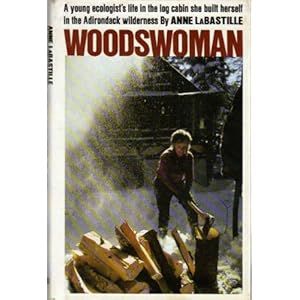
Anne LaBastille en lo profundo del bosque (y del corazón)


“Sometimes I sit in my log cabin as in a cocoon sheltered by swaying spruces from the outside world. … Life seems to have no beginning and no ending. Only the steady expansion of trunk and root, the slow pileup of duff and debris, the lap of water before it becomes ice, the patter of raindrops before they turn to snowflakes.”


1933-2011
Anne LaBastille often lived in a log cabin on Twitchell Lake without plumbing or electricity. (Associated Press)

Adirondack author whose "Woodswoman" autobiographies inspired others to venture into the wilderness, has died (2011) at a nursing home in Plattsburgh.


Autor-ecologista Anne LaBastille con Condor, su pastor alemán, cerca de ... (Associated Press) 


In 1974 she helped build her own small cabin at the northeast end of Twitchell Lake, near Big Moose Lake.
050-048-01-pix1

 Walk in the Woods | ANNE LABASTILLE'S ADIRONDACK LIFE


ONE ARM DRAPED COMPANIONABLY AROUND ITS TRUNK, Anne LaBastille pats the bark of a 300- year-old spruce and gazes toward its crown."Nothing's going to happen to you as long as I'm around," she tells it. This isn't the first tree LaBastille has hugged, nor is it likely to be her last. The selfproclaimed "evangelical environmentalist" makes her home deep within New York State's Adirondack Park, but has ranged around the world, conducting ecological surveys for the World Wildlife Fund in Panama and Guatemala and consulting in the Caribbean and the Amazon. Closer to home, she's penned a four-part memoir of her life on the land, worked as a certified Adirondack guide and governorappointed park commissioner, and taught courses on nature writing and women in the wilderness at East Tennessee State University and Cornell.

LaBastille '55, PhD '69, was in her late twenties and recently separated when she moved to the woods in the mid-Sixties. She would lose both her home and her livelihood--running an Adirondack resort--in the divorce, and yearned for a sanctuary. She found it in a thirty-acre tract of lakefront property and a new career. "At the hotel, I didn't have any time to write," she recalls. "All afternoon I dragged water skiers up and down the lake, then I had to fix drinks for the guests and supervise the waitresses." At her log cabin, whose location she scrupulously protects, she rises at dawn, takes a dip, drinks an espresso, and starts writing--at her desk, on the dock, or in a canoe on the lake. The routine has yielded a doctoral dissertation in wildlife ecology, 180 articles for scientific journals and such magazines as National Geographic and Ranger Rick, and ten books.
On a cool, cloudy morning in June, LaBastille motors a small boat up to a public landing at the end of a dirt road in a remote corner of the park. She wears black jeans and a tattered flannel shirt, frosted pink lipstick, and a red baseball hat pulled over her pigtails. Krispy Kreme, her nine-month-old German shepherd, rides along. The dock serves as LaBastille's front gate, the only point of access to what she refers to as her "spiritual center."After a two-mile lake crossing, she docks at West of the Wind, a 400-square-foot cabin the writer built herself in the late Sixties and has called home ever since. There is no central heating, no electricity, no bathroom. The outhouse stands a few hundred feet away, just out of sight.
In the last three decades, global warming has transformed the property from a year-round home to a seasonal retreat. Throughout the Sixties and early Seventies, LaBastille says, a thick sheet of ice blanketed the lake, making snowshoeing across its surface easy going from Thanksgiving through late April. Now rain showers in February and winter temperatures well above freezing make such ventures treacherous and unpredictable.Without a phone or year-round neighbors to call in an emergency, LaBastille no longer winters here.
Instead, she keeps an old farmhouse in a town 100 miles away. This is her first visit to the cabin since fall, and there's much to do. Inside, the propane lines haven't been checked yet, so the refrigerator and fourteen lanterns in the kitchen and study stand idle. To show off her sleeping loft, she clambers up four toeholds nailed to the rough-hewn logs that frame the cabin's interior."Mice have been up here," she announces, then collects the droppings in an old plastic deli container. Overall, though, she pronounces the place in good shape.
Several outbuildings, all constructed from logs felled on the land, dot the area near the cabin. Reaching the largest, a 100- square-foot writer's retreat the author has dubbed Thoreau II, requires a thirtyminute hike. A handwritten sign nailed to the door advises hunters and hikers that there are no valuables or liquor stored inside. Furnishings include a writing desk and three chairs "for sociability," she says, quoting Thoreau. Like her favorite author, LaBastille lives alone, far from society; even so, she has maintained close friendships with neighbors and fellow Adirondack guides, and a lively correspondence with her readers.
Each of the first three memoir installments chronicles a decade. The latest, Woodswoman IIII, released on Earth Day 2003, spans just five years. Despite the time between books, LaBastille doesn't keep a journal. "If I tell a friend about the experience, that cements it," she says. Once in a while, she posts a sticky note near the desk to jog her memory. She doesn't bother with computers or e-mail, either. Using a yellow pad and black pen, she drafts each manuscript longhand, then types it on a Smith-Corona manual. In the early Eighties, LaBastille launched her own publishing house, West of the Wind Publishing Inc., to escape "snippy-snappy" New York City editors and improve her profit margins. "I figured after five books, I knew what I needed to know," she says of her early days with E.P. Dutton, the Sierra Club, and Norton, which owns rights to the first two Woodswoman books. An additional five books, including Jaguar Totem and Woodswoman III and IIII, bear her imprint.
Krispy Kreme, who has orange tape tied to her collar--a cue to edgy neighbors who might mistake her for a coyote and shoot to kill--is the latest of five shepherds who have shared LaBastille's life in the woods. As a single woman without children, she relies on them for companionship and protection. Four graves occupy a hillock just feet from the cabin, each marked with a granite headstone and flowers. When the time comes, says the writer, her lawyer will return here with her ashes, recite poet Sara Teasdale's "Barter," and bury her with her beloved pets. Yet with two books in the works, she shows no signs of slowing down and scoffs at the possibility of retiring. Instead, she's making plans to preserve her property as a retreat for other nature writers. "This whole age thing in America is sick," she says. "It makes people seem like they're useless and dependent. I plan to keep writing and doing all the things I do until I drop dead."
-- Sharon Tregaskise
(http://cornellalumnimagazine.com/Archive/2004Julaug/depts/Currents.html)


LaBastilleWildlife ecologist, writer, and photographer Anne LaBastille (1933-2011) published four autobiographical books among her dozens of books and articles, Woodswoman being the first. Here she chronicles not so much an overt pursuit of solitude as an exploration of her personal accommodation with nature and people. As an avid naturalist, she built her own log cabin in the Adirondack forest, next to a lake, off the grid, away from roads and human habitation. "Ever since a childhood spent near New York City," she writes, "I had wanted to live in a Thoreau-style cabin in the woods." The motive was compounded by a divorce compelling her to quickly decide what she wanted to do with her unexpected solitude life.
The cabin becomes her physical and psychological sustenance, the embodiment of her solitude:
The cabin is the wellspring, the source, the hub of my existence. It gives me tranquility, a closeness to nature and wildlife, good health and fitness, a sense of security, the opportunity for resourcefullness, reflection, and creative thinking.
From childhood LaBastille's talent was both academic potential and nature. The book recounts intersections with a variety of people in an engaging narrative style, interspersed with adventures in the outdoors. But LaBastille is not a hermit (Noah John Rondeau and other local historical hermits she mentions only as local color); she is not a philosopher (she notes, of a mystery correspondent, that "it seems as if he were looking for a dream person, a recluse, a philosopher.") Her dealings with people always fall short of satisfying. Rather, the reader feels the physicalness of LaBasille's life trajectory, the ease with animals, trees, wind, water, snow, cold. Her circumambulations always return to the cabin. The book's epilog wistfullly summarizes her life in the cabin, as if it alone was permanent in the cycles of life:
Sometimes I sit in my log cabin as in a cocoon, sheltered by swaying spruces from the outside world. From traffic, and noise, and liquor, and triangles, and pollution. Life seems to have no beginning and no ending. Only the steady expansion of trunk and root, the slow pile up  of duff and debris, the lap of water before it becomes ice, the patter of raindrops before they return to snowflakes. Then the chirp of a swallow winging over the lake reminds me that ... there is always a new beginning.
http://www.adirondackexplorer.org/stories/2011/08/22/anne-labastille-1933-2011/
http://www.motherearthnews.com/multimedia/image-gallery.aspx?id=75554#ixzz1tqlvisEd
http://zintareviews.blogspot.com.es/2010/12/woodswoman-ii-beyond-black-bear-lake-by.html
http://www.adirondackalmanack.com/2011/07/remembering-anne-labastilles-environmental-record.html

jueves, 3 de mayo de 2012

La cabaña de Marshal South, el escritor del desierto


Marshal had become the desert prophet

Portraits of Tanya and Marshal in 1930

Marshal & Tanya South

"But the Book of Nature -- the same one that the Indian studied so successfully -- still is available free to all. And the Desert Edition of it, whose pages we on Ghost Mountain ruffle through every day by the aid of the wind and sunshine, always provides interesting items and food for thought."
-- Marshal South


One of the more interesting artifacts of California's Anza-Borrego Desert State Park is Yaquitepec on Ghost Mountain. According to publications, "the ruins of the South Home, where a family of nudists and writers lived in the 1930s, can be seen from the top of this short, steep trail that begins in Blair Valley, 2.7 miles from Highway S-2." 
The "South Home," actually an adobe cabin, was built by Marshal and Tanya South when they began homesteading in 1932, before the area was within the state park boundaries. From this "savage wilderness of rock," as Marshall called the summit of Ghost Mountain in eastern San Diego County, the Souths began an original experiment in desert self-sufficiency. 
They had no electricity, no artificial sources of light and only the sparest desert landscape as a source of fuel for heating and cooking. They had no neighbors within walking distance, no mail came to the door and few visitors ever made their way up the rugged and circuitous trail to their home. 
During their 14 year residence at what they called Yaquitepec, 3 children were born -- Rider, Rudyard and Victoria -- who were educated in the ways of the desert by their father, and the ways of the world by their mother. Both parents were well educated themselves and in spite of their primitive isolation, the South home contained many books, a typewriter, a camera and even a printing press. 
Marshal was a writer and artist who had published western novels, until the Great Depression had eliminated his source of income. He came to Ghost Mountain, he later wrote, "to break the mold," and allow his children the opportunity to grow up in an environment in which they would not be afraid to think for themselves. 
For more than 8 years, Marshal and Tanya were regular contributors to the estimable Desert Magazine. In a monthly column called "Desert Refuge," Marshal chronicled the family's experiment in primitive living, explaining how he, Tanya and their 3 children attempted to harmonize their lives as closely as possible with "Nature's universal code." Each column ended with Tanya's poetry and was illustrated with sketches or photos by Marshal. 
During their long sojourn on the mountain, Marshal discussed, through these monthly dispatches, the raising and education of their children, the search for water, fuel and food; the discovery of archeological sites, artifacts and petroglyphs; primitive basket making, adobe construction techniques and desert landscaping to name a few. Descriptions of desert plants and wildlife constituted a large part of these monthly columns, most famously the Desert Packrats and Desert Tortoises the children kept as pets. 
The Souths refused to denude their mountain of the few live shrubs and juniper, and so made long walks in search of the dry stalks of dead mescal to use as firewood. "Fuel gathering always adds to our desert knowledge, " Marshal wrote, "besides contributing to our well being, through healthy physical exercise. 
They also came to appreciate the varieties of uses this plant provided both Native Americans and themselves. Marshal maintained that there was no single growth on Ghost Mountain upon which his family was more dependent than the "savage, dagger-pointed Mescal and the "toothsome, pumpkin yam sweetness of the roasted mescal hearts." 
In addition to providing fuel, Mescal furnished footwear, cordage, clothing, food, drink, sugar, alcohol, vinegar, paper and soap. They also used it as brooms, paintbrushes, curtain rods, table legs and even napkin rings. They celebrated their good fortune that "here on Ghost Mountain, it is with malicious satisfaction that we hug to our bosoms the knowledge that the greedy hand of Commercialism is not likely to reach to these regions." 


By the mid-1940s, thanks to their monthly appearances in Desert Magazine, the South Family was becoming an early, desert version of the Truman Show. Many readers wrote to both the Souths and to Desert Magazine expressing their admiration, outrage, encouragement, curiosity and sometimes concern for the South children being raised in a home that had turned its back on modern civilization. 
"Most letters are from kindred souls," Marshal wrote in 1944, "who also feel the restless urge towards freedom and simplicity of living which is today tugging at the hearts of so many of the human race." 
"If it be our personal conviction that what 'Civilization' needs is not more softness and ease but more simplicity and nearness to the earth and fundamental things, then we are not alone." 
In September 1945, the U.S. Navy began using the Earthquake Valley area as a gunnery range, forcing the South family to leave their mountain homestead and seek refuge elsewhere. When they were allowed to return and resume residence in July 1946, few realized that the Ghost Mountain Experiment was already over. Before the end of the year, Marshal and Tanya South had separated. Marshal moved to nearby Agua Caliente, contributing occasional articles to Desert Magazine until, at the age of 62, a heart condition caused his death in October 1948 
In the Winter of 1947, Tanya found herself and the children in post-World-War II San Diego, where they rejoined civilization. In the spring of 1949, she reported through Desert Magazine that the children had become well-adjusted to their new circumstances and that all were doing extremely well in public school. Poet and artist Rider, then 15, was a freshman in high school and had just outgrown the Boy Scouts; 11-year-old Rudyard, the budding engineer, was captain of the baseball team and a nurse monitor; 8-year-old Victoria, then a third grader, was a chess player, rope jumper and had just learned to ride a bicycle. They were all voracious readers. 


According to Deborah Sperberg, volunteer naturalist at Anza-Borrego Desert State Park who gives a 25-minute talk on the South family, Tanya insisted on remaining private after leaving Ghost Mountain and shunned all interviews. The two younger children are said to have renounced their former life and eventually changed their names to avoid public scrutiny. 
New information on Marshal South
Bob Katz
(http://www.desertusa.com/mag99/mar/papr/mtsouth.html)


Marshal South House (#41) — by Joe Reifer
For 17 years, from 1930 to 1947, poet, artist, and author Marshal South and his family lived on Ghost Mountain – a remote, waterless mountaintop that is today within California’s Anza-Borrego Desert State Park. Over a period of nine of those years, South chronicled his family’s controversial primitive lifestyle through popular monthly articles written for Desert Magazine.
- From the article Finding the Real Marshal South, by Diana Lindsay

Marshal doing pottery with Rider watching.

Strange Geographies: the House on Ghost Mountain
by Ransom Riggs


Deep in California’s Anza-Borrego desert wilderness — an hour from the nearest town, miles from the nearest paved road, atop the rocky crags of a mountain stippled with razor cactus — is a house. Or the remains of one, at least, built and occupied for sixteen years by a noted writer and his family, who wanted to live off the land like Native Americans. Some people think Marshal South was crazy, others consider him an inspiration; one thing everyone can agree on is that he was interesting.
People wonder why South would build a house so far from civilization, and in such an unforgiving place — that is, until they hike the steep, mile-long trail to his old home site, and discover the views he enjoyed; the thin white roads and spectral light that spills across the Blair Valley is what earned Ghost Mountain its name.

IMG_5769

Marshal South was the pen-name of an Australian ex-pat who came to America just after the turn of the last century, and who made a career for himself writing novels about the Wild West. Finally, after writing about it for so long, South decided to live it — conducting an “experiment in primitive living” — and in 1930, he and his wife Tanya moved to the waterless ridge in the desert that became known as Ghost Mountain. Over the next 16 years they raised a family there, and became known to readers across the country through a series of articles Marshal wrote about their lives in the career for himself writing novels about the Wild West. Finally, after writing about it for so long, South decided to live it — conducting an “experiment in primitive living” — and in 1930, he and his wife Tanya moved to the waterless ridge in the desert that became known as Ghost Mountain. Over the next 16 years they raised a family there, and became known to readers across the country through a series of articles Marshal wrote about their lives in the Saturday Evening Post and Desert Magazine.

South family summer 1946

They lived as close to the land as they could, building their home from adobe they made themselves, and fashioning an ingenious system of cisterns to catch and store rainwater. Here’s what’s left of the cisterns today:

IMG_5758

IMG_5756

The house as it was. You can see the cistern pictured above on the left side of the frame.

Rider and Rudyard in front ofYaquitepec by the "lake".


Not much remains of the house today — over the years, the adobe structure has literally melted into the desert. The door frame and an iron bed are two of the homestead’s most obvious remnants.

IMG_5770

In the years before the cisterns were built, the only way the Souths got water was by driving it from a faraway town in their Model A Ford, then carrying it one mile up the mountain, by hand, twelve gallons at a time. Here are the Souths bringing some corrugated roofing up the side of the mountain:

74--M & T w corrugated roofing 6-15-31

They were forced to move for a short period of time during World War II, when the Army informed the Souths that their mountain was in the path of a gunnery range. Finally, in 1946, the Souths separated and divorced — though they never talked about it publicly, friends speculated that Tanya saw no future for their children in the desolate wilderness where they lived; Marshal, who was raised in the Australian outback, saw no problem with it. The house was sealed and left to the elements, and 64 years later, little more than traces remain.
Another basin for catching water:

IMG_5772

As with any abandoned site or ghost town, there is some trash. However, because the Souths lived off the land as much as they could — hunting rabbit, eating cactus, raising bees for honey, and grinding what grain they bought by hand — there isn’t much. I found evidence, though, that the Souths enjoyed the odd canned delicacy:

IMG_5776

It’s a beautiful spot, but not a place that made me want to plant my flag and never leave. It’s amazing that any modern people could live so primitively — and, for a time, even thrive here.

--brought to you by mental_floss! 


http://www.desertusa.com/mag05/jan/south.html
http://www.californiachaparral.com/wildnesswithin.html

martes, 1 de mayo de 2012

"Soplan vientos" en las altas tierras de Teruel


Construir... habitar... pensar... sentir


molino de damaniu (la) cabaña

El Colectivo Sollavientos en el Molino de Damaniu (21 de Abril de 2012)
Foto: Gonçal Tena
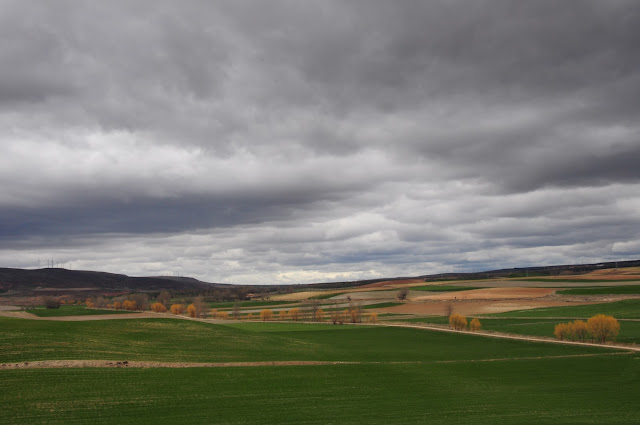
El hermoso valle de La Val amenazado por el trazado de una línea de alta tensión en contra de sus habitantes. 
Foto: Gonçal Tena

Las estatuas que contemplan el valle de La Val, como el Guernica picasiano parecen horrorizadas ante semejante desaguisado.
Foto: J. L. Penalba