El tema central de este Blog es LA FILOSOFÍA DE LA CABAÑA y/o EL REGRESO A LA NATURALEZA o sobre la construcción de un "paradiso perduto" y encontrar un lugar en él. La experiencia de la quietud silenciosa en la contemplación y la conexión entre el corazón y la tierra. La cabaña como objeto y método de pensamiento. Una cabaña para aprender a vivir de nuevo, y como ejemplo de que otras maneras de vivir son posibles sobre la tierra.

domingo, 30 de marzo de 2014

Resiliencia


La Resiliencia es un término para describir el proceso por el cual un ser humano se repone de una situación de mierda en su vida. Una posición subjetiva ante la adversidad.

Re-leyendo a Henry David Thoreau para encontrar, otra vez, la inspiración del sueño de cabañas y bosques que tanta falta nos hace:


“Me fui a los bosques porque quería vivir sin prisa.
Quería vivir intensamente y sorberle todo su jugo a la vida.
Abandonar todo lo que no era la vida, para no descubrir,
en el momento de mi muerte, que no había vivido”


Lost in translation, 2003 (Tokio según Sofia Coppola)
Bill Murray y Scarlett Johansson en
Lost in Translation dirigida por Sofia Coppola


“Soñamos días de mañana
que nunca llegan.
Soñamos una gloria
que no deseamos.
Soñamos un nuevo día
cuando ese día ya ha llegado.
Huimos de una batalla 
en la que deberíamos pelear. 

Y sin embargo dormimos. 

Esperamos la llamada 
sin adelantarnos a ella. 
Basamos nuestras esperanzas en el futuro 
cuando el futuro no es más que vanos proyectos. 
Soñamos con una sabiduría 
que evitamos cada día. 
Llamamos con nuestras plegarias a un salvador 
cuando la salvación está en nuestras manos. 

Y sin embargo dormimos. 

Y sin embargo dormimos. 
Y sin embargo rezamos. 
Y sin embargo tenemos miedo”

Henry David Thoreau 


sábado, 29 de marzo de 2014

Un espacio para pensar


Estudio del Molino de Damaniu. Agosto 2012. Foto de Alba Guilera

(...) Arriba, en el estudio, el balcón cerrado. Afuera, nublado y una suave llovizna. Dentro, olor a biblioteca. El recalentamiento del estudio por el sol de verano, intensifica la aroma a madera del interior del molino. Esto es lo que buscaba mi ser. El olor a escuela de pueblo o de biblioteca. El olor de la infancia perdida y ahora reencontrada. Madera y más madera. ¡Dadme madera y ...!, madera para oler la vida.

(...) El paraíso esta aquí. El infierno también. 
Catedral. Monasterio. Refugio. Cabaña. Viento del este.

(...) La naturaleza (el sol, el viento, el paisaje, el tintineo de las hojas del viejo olmo, ningún rastro humano en el horizonte ...) lo atempera, lo apacigua todo. 

(...) "Desafiando siempre la tormenta", cantan. 
"Vivo sin más ... yo soy de la tierra ... soy como la tierra", cantan. 
"Al final la disidencia nos traerá el conocimiento", cantan. 

(...) La cabaña es la condensación de un deseo infantil. 

(...) No debería preocuparme por el ruido de las cosas. El silencio es un regalo de los dioses.  
Regar, cavar, clavar, podar, sulfatar, cocinar, pintar, escribir, caminar, leer, oír música, cantar, respirar, mirar, escuchar, pensar, sentir .... 

(...) Una música sufí, envuelve como un velo, la melancólica espiritualidad de mi silencio sonoro. 

(...) El manzano no dice nada, no habla, tampoco piensa, solo está ahí. A veces baila al compás del viento que lo acaricia


El manzano del molino. Foto de Alba Guilera


Textos de " Un espacio para pensar "  de Gus Cierzo


sábado, 1 de marzo de 2014

domingo, 9 de febrero de 2014

William Coperthwaite, un visionario en busca de la simplicidad


coperthwaite-1
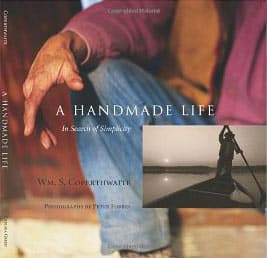
William S. Coperthwaite (1930-2013), a native of Maine, U.S., pioneered yurt building in the United States.For his book A Handmade Life: In Search of Simplicity, he received theNautilus Book Award.


"Only by standing on their shoulders can we build a better world, but we should use the wise as advisers, not masters."


“Each of us tries to live in the best way we know how. I want to contribute to the problems of the world as little as possible. I really believe we must find simpler ways to live or society will collapse.”


 The yurt compound of William Coperthwaite near Machiasport, Maine. 

No one alive has done more to promote yurts than Bill Coperthwaite. Coming across the style in a 1962 National Geographic article, he recognized in the yurt a construction method so simple and durable, that almost anyone, regardless of skill or budget, could build their own home. He’s spent the last 4 decades living off-grid, lecturing, selling plans, and leading hundreds of yurt building workshops around the globe.

Read more on Bill’s life and philosophy in his book: A Handmade Life.

Photographs by the exceptional A. William Frederick.


Rest in Yurt: Bill Coperthwaite

Bill Coperthwaite was killed in a car accident at the age of 83 on his way to a Thanksgiving celebration last week (2013, report). So shocking and sad.

Bill Coperthwaite dove into indigenous crafts and brought the yurt to America. He lived sustainably on land in Maine and wrote the beautiful book, A Handmade Life: In Search of Simplicity.

I read the book looking for a how-to of sustainable living. What I received, instead, was an extended poem of simplicity that imparted the flavor of the pace of his life, the wind in the trees, the grace of his yurts, his thoughts on educating children. I was also invited into a new concept for me, the thought of “democratic technology”, by which he meant technology that anyone could use to build what they need. For example, the book contains a diagram that illustrates how to build a “democratic axe” and a “democratic chair”. Though the chair and the axe are a little ugly from my perspective, their beauty comes from the fact that anyone could build them with limited expertise and equipment — that is, they are democratic objects.

He also got me thinking about a new field, the field of life design: the intentional design of a whole life. In my mind, Bill joins others who have come before us who lead the way and inspired by example. They include Thoreau, Scott and Helen Nearing, Eliot Coleman, and so many others. Bill and these other life design faculty have taught us much about what we’ll need to thrive on one planet. Thank you Bill.

Fuente: http://oneplanetthriving.com/2013/12/rest-in-yurt-bill-coperthwaite/


Dead Time
Bill Coperthwaite

Why not get some horses?”
Comes over the water,
From a 30-foot lobster boat
With 300 horses,
To my 20-foot canoe with
A one-man cedar engine
It’s a two-mile paddle to haul supplies
By rock-bound shore and gnarled spruce.
Osprey “float” above with sharp cries.
A startled heron croaks displeasure
Waiting for the tide to drop.
If lucky – there may be otter kits
Playing in the shallows
At the tide rips.
An eagle perches on a snag,
Loon laughter lilts over the bay,
A seal looks me over.
A motor would take half the time –
But, what with mounting it,
Feeding it, and keeping it in tune,
Would there really be a gain in time?
True – I could go when the wind is
Too strong to paddle
But that is a non-problem.
The racket, the stench, the poisons –
There is the problem.
Oh – I could still see (most of) the birds
But not hear them
And the otters – they’d be gone.
The paddle – lovely yellow cedar –
Carved on a beach in the San Juans,
Has served me well these thirty years.
While paddling the brain does delightful things,
Each moment a surprise – a treasure.
Motoring puts all that on hold,
Thieving those precious minutes –
My brain turned off:
Dead time.


http://cabinporn.com/page/8 
http://en.wikipedia.org/wiki/William_Coperthwaite
http://www.youtube.com/watch?v=XW2xwfKzU6g
http://pfollansbee.wordpress.com/tag/bill-coperthwaite/


viernes, 13 de diciembre de 2013

"Vivir con menos" y cabaña


Un granjero desafía las hipotecas y se hace una casa por 240 dólares.

Un ingenioso granjero británico ha construido una casa ecológica por tan solo 150 libras esterlinas (unos 240 dólares) para demostrar que es posible poseer una vivienda sin acudir a las hipotecas bancarias y sin endeudarse de por vida.


Según el diario ‘Metro’, Michael Buck, un exprofesor de 59 años de edad, edificó una llamativa cabaña en su terreno, que se encuentra en un placentero lugar boscoso cerca de Oxford, Reino Unido.

Buck indicó que construyó la pequeña casa con sus propias manos en ocho meses, sin la ayuda de herramienta eléctrica alguna. Explicó también que levantó las paredes usando una mezcla de arena, arcilla, paja y estiércol de vaca. Mientras que para el techo armó una estructura de madera y lo cubrió con paja. 

Michael tampoco tuvo problemas con la cubierta del piso, que cubrió con tablas sacadas de una vieja casa abandonada. Además, usó los parabrisas de un viejo camión para cerrar las inusuales ventanas de su casa.


La inusual cabaña cuenta con una cocina, comedor y una cama que se encuentra en un espacio elevado a media altura. El inmueble no cuenta con electricidad, pero una estufa de leña proporciona calor, mientras que el agua es llevada por una tubería desde un manantial natural cercano.

Asimismo, un pequeño pozo junto a la puerta de entrada sirve como nevera. Tampoco dejó pasar por alto el baño, para lo cual detrás de la casa construyó una letrina cubierta con paja, desde donde “se abren espectaculares vistas panorámicas de la campiña”.


“Una casa no tiene por qué costar un ojo de la cara, solo se necesita la tierra para construir”, dijo Buck, quien ya ha arrendado su obra a otro granjero por un litro y medio de leche fresca.

“Quise desafiar a las hipotecas, demostrar que las personas no necesitan trabajar toda su vida para pagar un préstamo. No hay que pagar grandes cantidades de dinero por una casa, todo lo que necesita es un terreno para su construcción”, señaló el ingenioso granjero.

Concluyó: “Originalmente planeaba construir invirtiendo los mínimos recursos, pero calculé mal la cantidad de paja y tuve que comprar más. Por eso la casa me costó 150 libras”.
Fuente: RT News
(http://fahrenheit2012.wordpress.com/2013/11/29/cansado-de-bancos-un-granjero-desafia-las-hipotecas-y-se-hace-una-casa-por-240-dolares/)


Cob the builder: Farmer Michael Buck loads a barrow during construction of the house he spent just £150 on (Picture: NTI)


It’s the home that’s got spadefuls of rustic charm, sits in an idyllic woodland setting… and cost only £150. 

Resourceful farmer Michael Buck avoided using a single power tool while making the house using the ancient method of cobbing. 

With no hefty mortgage to worry about, he’s happy to be paid in pints of milk by the dairy farm worker he’s let it out to. 

‘A house doesn’t have to cost the Earth – you only need earth to build it,’ he said. 

Mr Buck, 59, spent two years working on the environmentally-friendly house, which has a kitchen and a dining area and a bed in the roof-space. 

He learned to thatch to make the roof and used earth, clay, straw and cow dung for the mucky cobbing mixture the walls are made of. The floorboards came from a neighbour’s skip and the windows are made from the windscreen of an old lorry. 

There is no electricity – but a wood-burner provides heat, running water is supplied by a natural spring and a shallow well outside the front door acts as a fridge. 

Would-be homebuyers tempted by the idea of a £150 house should know that Mr Buck had an advantage – he built it on land he already owned at his smallholding near Oxford. 

But the former art teacher hopes to provoke debate – even if councils might take a dim view of mud huts springing up in the city. ‘There’s this idea that people must spend their lives paying the mortgage, which I wanted to challenge,’ he said.

(http://metro.co.uk/2013/11/25/sick-of-soaring-rents-try-making-a-150-home-out-of-mud-and-cow-pats-4201803/) 


jueves, 12 de diciembre de 2013

La cabaña del desierto o el desierto en la cabaña


Lucid Stead: espejismos en el desierto


Se ha dicho del espejo que es símbolo de la imaginación o de la conciencia, pues reproduce los reflejos del mundo visible en su realidad formal. Algunos filósofos lo han relacionado con el pensamiento, pues el reflejo es el vehículo mental en el que se produce la autocontemplación y el Universo “comprensible”. Pero, ¿qué pasa con lo comprensible cuando no se concibe dentro de la realidad? Estos reflejos del mundo visible también distorsionan la imagen establecida.


En el desierto de California se erigían los restos de una cabaña de madera que el artista Phillip K Smith III intervino con espejos para crear una ilusión de transparencia en medio del desierto. La estructura, casi en ruinas, ahora toma la iluminación de todo lo que lo rodea bajo el título: Lucid Stead.

Paneles intercalados de espejo y madera crean en la choza rayas horizontales alrededor de los muros exteriores, permitiendo así que secciones estrechas del edificio aparentemente desaparezcan en el vasto paisaje desértico.


La puerta y ventanas del edificio también son rellenadas con espejos, pero por la noche se transforman en rectángulos de colores brillantes que cambian sutilmente el tono, gracias a un sistema de iluminación LED y un sistema informático Arduino.


Con Lucid Stead el movimiento del Sol se refleja en destellos de luz a través del paisaje del desierto, mientras diferentes grietas y aberturas se revelan dentro de la estructura. Sobre las ventanas y puerta comienza a moverse la noche, pues se convierten en campos rectangulares de brillantes colores que flotan en la oscuridad del desierto.


Es también durante la noche cuando la luz blanca, proyectada desde el interior, deja ver las grietas entre la madera y los espejos sólo para envolver la choza en líneas azules que exponen la estructura propia de la cabaña, ahora intervenida. El artista describe a Lucid Stead como un proyecto que aprovecha la tranquilidad y el ritmo del desierto. “Cuando vas más despacio y se alinea con el desierto, el proyecto comienza a desarrollarse antes que tú”.


Phillip K Smith III es licenciado en Bellas Artes y Arquitectura por la Escuela de diseño en Rhode Island. Se inspira en la lógica reduccionista y la sensación óptica de movimiento, luz y espacio de California.


LouMora.LucidStead.004
LouMora.LucidStead.002
LouMora.LucidSteam.013
Lucid Stead by Phillip K Smith III in Joshua Tree 8 580x435 Lucid Stead   Colores en la oscuridad del desierto
lucidstead 004 Lucid Stead   Colores en la oscuridad del desierto
LouMora.LucidStead.005
LouMora.LucidStead.007


La mayoría de las fotos fueron tomadas por Lou Mora.


http://loumora.com/2013/11/04/lucid-stead/
http://culturacolectiva.com/lucid-stead-espejismos-en-el-desierto/
http://pousta.com/2013/11/25/lucid-stead-colores-en-la-oscuridad-del-desierto/


domingo, 8 de diciembre de 2013

Cabaña de Saigyô Hôshi, poeta japonés de la melancolía


“La cabaña deja entrar el agua cuando llueve, y yo estoy mojado.
Pienso en la amable visita de la luna”
-Saigyô Hôshi 


Saigyō Hōshi en el Ogura Hyakunin Isshū.

Saigyō
Saigyō o Saigyō Hōshi (西行法師? Kioto, 1118 – provincia de Kawachi, 1190) fue un monje y poeta japonés de finales de la era Heian y comienzos de la era Kamakura.

Nació en una familia noble en Kioto, con el nombre de Satō Norikiyo, durante un momento tenso en donde el poder del país estaba pasando de las familias cortesanas a los clanes samurái. También durante su vida, el budismo había entrado en un período de declive, en donde predominaba el concepto de Mappō. Estos cambios condujeron a que sus obras poéticas tuvieran una fuerte sensación de melancolía.

Durante su juventud, fue guardián del Enclaustrado Emperador Toba, pero en 1140, a la edad de 22 años, decide cambiar su estilo de vida de manera drástica convirtiéndose en un monje budista, y toma el nombre religioso de En'i (円位). Posteriormente tomó el seudónimo de “Saigyō”, que significa “Viajero del Oeste”, haciendo referencia al Buda Amida y al Paraíso Occidental. Vivió comoermitaño en largos períodos en Saga, el Monte Koya, el Monte Yoshino, Ise y otros lugares, pero es mayormente conocido su largo viaje al norte de Honshu, en donde realizó varios viajes poéticos. Este suceso sería inspirado posteriormente por Matsuo Bashō en la obra Oku no Hosomichi.

Tuvo una fuerte amistad con Fujiwara no Teika. Algunas obras de Saigyō se encuentran en las antologías poéticas Sankashū, Shin Kokin Wakashū y Shika Wakashū. Falleció en el Templo Hirokawa en la provincia de Kawachi (actual prefectura de Osaka) a la edad de 72 años.

Durante su vida, el Man'yōshū ya no era una obra influyente en la poesía waka; y había sido reemplazado por la antología Kokin Wakashū, de carácter subjetivo, con juegos de palabras y una dicción elegante (ni coloquial ni imitado de la poesía china). Con la compilación del Shin Kokin Wakashū, en donde las poesías de Saigyō y otros contemporáneos fueron publicadas, tenían poca subjetividad, no habían juegos de palabras, muy repetitivas con pocos verbos y muchos sustantivos, dando un carácter sombrío y melancólico.

Dado la crisis política surgida a finales de la era Heian y comienzos de la era Kamakura, Saigyō se enfocó no solo en la reclamación de un cambio, sino en aplicar los conceptos de wabi-sabi(soledad) y kanashi (tristeza). Como monje budista, en sus obras se enfocó también al mundo y a la belleza de la naturaleza.

Saigyo
Saigyo y su choza de paja en Yoshino (actual Wakayama District)


http://es.wikipedia.org/wiki/Saigy%C5%8D


miércoles, 4 de diciembre de 2013

Edward MacDowell y su cabaña en los pinos


Edward Alexander MacDowell (1860-1908) [biography]

Edward Alexander MacDowell, head-and-shoulders portrait, seated, facing right, between 1890 and 1908. Prints and Photographs Reading Room, Library of Congress.
Edward MacDowell was one of the most celebrated American composers in the nineteenth century. His compositions won the approval of music critics, both in Europe and the United States, as well as of his contemporaries, including composers such as Franz Liszt and Joachim Raff. MacDowell's early works bear the influence of his training in Germany, reflecting European styles and cultures. Nearly all of his compositions feature descriptive titles, a trend representative of Romantic music. He was among the first seven Americans honored by membership in the American Academy of Arts and Letters (1904).
While there has been controversy in determining his birth year, recent evidence suggests that MacDowell was born in New York City on 18 December 1860. The son of Thomas MacDowell and Frances "Fanny" Knapp MacDowell, the youth grew up in a Quaker household on the Lower East Side of Manhattan. Frances MacDowell firmly believed that Edward should have music lessons, so she arranged for her eight-year old son to take piano lessons from Colombian violinist Juan Buitrago. MacDowell soon surpassed Buitrago's abilities and began studying piano with Cuban pianist Pablo Desverine. Desverine's lessons were supplemented by sessions with Venezuelan pianist Teresa Carreño, who later championed MacDowell's works.
In 1876, at the age of fifteen, MacDowell, accompanied by his mother, traveled to France to enroll in the Paris Conservatoire. He earned one of the conservatoire's scholarships awarded to foreign students and gained admission to Antoine François Marmontel's studio. Marmontel was one of the most sought-after piano teachers of the time, and he accepted only thirteen students, including MacDowell, out of 230 applicants. After only two years, MacDowell grew dissatisfied with the instruction at the conservatoire and moved to Germany to continue his education.
In the fall of 1879, MacDowell entered the Frankfurt Conservatory, where he studied piano with Carl Heymann and composition with Joachim Raff. It was during this time that MacDowell became acquainted with Franz Liszt. Upon visiting Raff's class in early 1880, Liszt heard MacDowell play the piano part of Robert Schumann's Quintet, op. 44 (Schumann's widow, Clara, was also present at that performance). The following year, MacDowell visited Liszt in Weimar and played his own Piano Concerto in A Minor, op. 15, for the maestro. On Liszt's recommendation, MacDowell's First Modern Suite, op. 10, was performed on 11 July 1882 at the Allgemeine deutsche Musikverein; Liszt also encouraged the prestigious Leipzig firm of Breitkopf & Härtel to publish the work.
After Heymann's retirement in 1881, MacDowell began his professional career as a teacher at the Darmstadt Conservatory. He resigned a year later, but continued to teach privately. He fell in love with one of his students, Marian Nevins, whom he secretly married on 11 July 1884 (a public ceremony followed on 21 July). The couple lived in Germany for several years, during which time MacDowell dedicated himself solely to composition. He achieved fame with his Piano Concerto in A Minor, op. 15, which was championed by Carreño, and his Fantasy Pieces, op. 17.
Financial difficulties forced the MacDowells to return to America in 1888, and for nearly ten years they resided in Boston. Among the compositions penned by MacDowell during this period was his Indian Suite, op. 48 (1896), for orchestra, one of his most famous works. In 1896 the MacDowells purchased land in New Hampshire, and in a cabin built on this property, Edward composed his Woodland Sketches, op. 51 (1896), for piano. The natural surroundings of this New Hampshire retreat would ultimately inspire generations of composers, for it was in this location in 1907 that the MacDowell Colony was established. The colony, a sanctuary for composers, painters, authors, and sculptors, continues to sponsor and support artists to this day.
MacDowell joined the faculty of Columbia University in 1896. As the sole music professor at the university for nearly two years, MacDowell also served as the department's administrator. In addition to teaching, he directed the Mendelssohn Glee Club (New York). He also started an all-male chorus at Columbia University in order to raise artistic standards of college glee clubs and music societies.
MacDowell's compositions include two piano concertos, two orchestral suites, four symphonic poems, four piano sonatas, piano suites, forty-two songs, and choral music, most of which is for male voices. He also published dozens of piano transcriptions of eighteenth-century pre-piano keyboard pieces.
MacDowell wrote a great deal of solo song repertoire between 1880 and 1901. Early songs were on German texts by Heine, Klopstock, and Goethe; later he set texts by Shakespeare, Burns, Gardner, and Howells, as well as his own poetry. For the Mendelssohn Glee Club, he wrote nine arrangements for male voices of works by Borodin, Sokolov, Rimsky-Korsakov, and others, which the Club premiered. He also arranged and composed college songs for Columbia University's men's glee club.
From 1896 to 1898, MacDowell published four part songs for the Mendelssohn Glee Club under the pseudonym of Edgar Thorn. Since MacDowell conducted the group, he feared members would feel obligated to accept his compositions if he revealed he had written them. MacDowell also wrote nine other works under his own name. Eight of his works were premiered by the Mendelssohn Glee Club under his direction between 1897 and 1898.
In 1904, after serious disputes with Murray Butler (the new president of Columbia) regarding the role of the university's music program, MacDowell resigned from the post. As a result of the trauma associated with the much-publicized event at Columbia, an accident with a hansom cab, and his depression and general declining health, MacDowell's condition rapidly deteriorated, and he died on 23 January 1908. Marian MacDowell, however, survived her husband by nearly five decades, spending the majority of her remaining years tending to the MacDowell Colony's operations. After Marian's death in 1956, her estate sold MacDowell's materials to the Library of Congress in 1972, allowing researchers and scholars access to the holograph manuscripts, correspondence, and personal papers of one of America's most prominent composers.

Further Reading:
Levy, Alan H. Edward MacDowell: An American Master. Lanham, Maryland, and London: Scarecrow Press, 1998.
MacDowell, Marian. Random Notes on Edward MacDowell and his Music. Boston: Arthur P. Schmidt and Co., 1950.
Last Updated: 08-26-2011
Fuente: http://lcweb2.loc.gov/diglib/ihas/loc.natlib.ihas.200035715/default.html


MacDowell Colony
History

In 1896, Edward MacDowell, a composer, and Marian MacDowell, a pianist, bought a farm in Peterborough, New Hampshire, where they spent summers working in peaceful surroundings. It was in Peterborough that Edward, arguably America’s first great composer, said he produced more and better music. Not long after — falling prematurely and gravely ill — Edward conveyed to his wife that he wished to give other artists the same creative experience under which he had thrived.

Before his death in 1908, Marian set about fulfilling his wish of making a community on their New Hampshire property where artists could work in an ideal place in the stimulating company of peers. Their vision became nationally known as the “Peterborough Idea,” and in 1906, prominent citizens of the time — among them Grover Cleveland, Andrew Carnegie, and J. Pierpont Morgan — created a fund in Edward’s honor to make the idea a reality. Although Edward lived to see the first Fellows arrive, it was under Marian’s leadership that support for the Colony increased, most of the 32 studios were built, and the artistic program grew and flourished. Until her death in 1956, she traveled across the country to further public awareness about the Colony’s mission, giving lecture-recitals to raise funds for its preservation.

At its founding, the Colony was an experiment with no precedent. It stands now having provided crucial time and space to more than 6,000 artists, including such notable names asLeonard Bernstein, Thornton Wilder, Aaron Copland, Milton Avery, James Baldwin, Spalding Gray, and more recently Alice Walker, Alice Sebold, Jonathan Franzen, Michael Chabon, Suzan-Lori Parks, Meredith Monk, and many more.

In 1997, The MacDowell Colony was honored with the National Medal of Arts — the highest award given by the United States to artists or arts patrons — for “nurturing and inspiring many of this century’s finest artists” and offering them “the opportunity to work within a dynamic community of their peers, where creative excellence is the standard.” In 2007, the Colony celebrated its Centennial with a yearlong celebration of the freedom to create. You can browse through MacDowell's history by viewing the Centennial timeline here.


Marian MacDowell at the Log Cabin, the studio she built for her husband, composer Edward MacDowell. Photo credit: Archival image.

Marian MacDowell in front of Edward's log cabin, the Colony's prototype studio. Archival image.

The "House of Dreams Untold"—the log cabin in the woods at Peterboro where MacDowell composed, and where most of his later music was written


http://lcweb2.loc.gov/diglib/ihas/loc.natlib.ihas.200035715/default.html
http://www.gutenberg.org/files/14109/14109-h/14109-h.htm
http://www.macdowellcolony.org/about.html


sábado, 23 de noviembre de 2013

La cabaña escarabajo de Terunobu Fujimori


terunobu fujimori: beetle's house


Beetle's house is the name for the raised home designed by japanese architect terunobu fujimori which is currently on display as part of ‘1:1 - architects build small spaces’ at the v&a museum in london. 
The small dwelling sits in the museum’s medieval & renaissance room, high atop its pillared structure. 
The design is clad in rich black charred pine beams that no doubt reference the colour of the beetle. 
This type of wood creates a unique texture that preserves the wood and extends the building’s lifespan. 
The structure, like fujimori’s other works is intended to by-pass all architectural styles that have developed since the bronze age, returning the act of living to a more primitive state. this home is designed to host an english version of the traditional japanese tea ceremony. its is only accessible through a small hatch in the floor which visitors enter from a ladder. 


image: pasi aalto
image: pasi aalto
image: pasi aalto
image: pasi aalto
image: pasi aalto
image: pasi aalto


(Fuente: http://www.designboom.com/architecture/terunobu-fujimori-beetles-house/)


tree tea house


Japanese architect, Terunobu Fujimori, has designed a tree-tea-house called Takasugi-an (tea-house built too high) on a family owned plot in Chino, Nagano (Japan).

Two chestnut trunks without roots support the house, and the only way to reach it is a freestanding ladder that increases the game’s sense. There’s no safety net and you can reach it just if you trust in the architect and if you are brave. In the middle of your climbing to the top, you have to take off your shoes. Inside is padded with plaster and the flat is made of bamboo mats, and the surface corresponds of four and a half tatami (mat used in Japanese architecture as modules).
Terunobu Fujimori Interview_I’m sorry it’s in japanese, but you can see the tree house in all its aspects!
From the only window -that reminds to the traditional kakejiku (a scroll painting or calligraphy mounted usually with silk fabric edges on a flexible backing) a characteristic element of the Japanese tea-houses- people can see the surrounding landscape, its seasonal changes, and Chino transformation.
Inside is very simple and rational typical of the Japanese architecture, the absence of any object is planned, to increase the meditation.
The water for the tea is boiled on a fire, that warms the habitation also in the winter days. Usually they prepare Matcha tea and for sure two of the four fundamental principles of Japanese ceremony are realized: “Wa”, the harmony between people and nature, harmony of tools and the way they are used, and “Jaku” tranquility and peace of your mind, it’s a consequence of the other three principles (Wa, Kei and Sei)
.
(Fuente: http://hometreehome.wordpress.com/2012/03/30/158/)

Beetle’s House - Terunobu Fujimori, Tokyo, Japan from Victoria and Albert Museum on Vimeo.

Terunobu Fujimori, a professor at the Institute of Industrial Science at the University of Tokyo and a historian of modern Japanese architecture, began designing buildings in 1991.
Transcript:
Terunobu Fujimori (sub-titled translation): The recurring theme which I play with in my work is the relationship with the natural world and what human beings have created. I go about this by using natural materials, such as trees and soil in the building of my homes and also by using plants within the buildings.
The focus of my work relates back to architecture before civilisation. How people originally lived, in their natural environment, which is a key subject of my architectural works. I’ve visited Stonehenge many times and other Neolithic sites, walking around and looking at them.
Abraham Thomas: … so this is where the structure will be, pretty much where that bench is. Very close to the Morlaix Staircase.
Terunobu Fujimori (sub-titled translation): I want to create a space that we can enjoy away from our everyday lives, a space with a small fire where people can enjoy tea.
There are seven architects taking part in this project, I know just one of them, the Japanese architect Fujimoto. I know Fujimoto very well. I’m really looking forward to seeing the works by the other five.


http://www.designboom.com/architecture/terunobu-fujimori-beetles-house/